
Pelican Bay Release Path
Pelican Bay State Prison, often called PBSP, is a CDCR institution in Crescent City. It is a state prison, not a county jail. That distinction controls the records path. A person released from PBSP is searched through CDCR/CIRIS while in CDCR custody, CDCR records when a release or discharge record is needed, DAPO when parole follows, BPH when parole suitability is involved, VINE for custody-change notice, and the sentencing court for the order or abstract behind the release.
The Del Norte County Jail roster should not be used as the PBSP release source. A state prisoner may pass through a county jail for court transport or a new local booking, but that is a separate event. The county portal can show local jail booking status. It does not publish a Pelican Bay released-prisoner list. When a search phrase says Del Norte County released inmate but the person was housed at PBSP, the correct route is the statewide CDCR path.
Confirm Pelican Bay Release
CDCR's public search is the first state source because it can identify current CDCR custody, CDCR number, age, current location, commitment counties, admission date, and Board of Parole Hearing information for people currently in CDCR custody. CA.gov describes CIRIS as focused on currently incarcerated persons, so a person fully discharged from CDCR may not remain visible the same way a current prisoner does. That limit is why a PBSP release often needs more than one source.
- Search CDCR/CIRIS by CDCR number when known, or by name.
- Confirm the record with CDCR number, age, current location, commitment county, and admission date.
- Review any BPH date or outcome fields shown for the person.
- If the person is no longer found or the result does not show a final status, use CDCR records, DAPO, VINE, and court records.
- For release caused by resentencing or a court order, request or review the abstract of judgment, minute order, or release order.
For exact inmate-location questions, CA.gov lists the CDCR locator phone as 916-445-6713. For institution-specific routing, PBSP lists its main phone as 707-465-1000. Phone confirmation is especially useful when a public search result has not caught up with a court order, parole process, transfer, or discharge.
Pelican Bay Records Contact
PBSP's official CDCR facility page supplies the core contact information. The institution address is useful for identifying the facility tied to the release record, but most release confirmation still flows through CDCR records, case records, parole operations, BPH, or the court. Mail addresses should be used only for the purpose CDCR assigns to them.
Pelican Bay State Prison
5905 Lake Earl Drive
Crescent City, CA 95531
Main phone: 707-465-1000
Institution mail: P.O. Box 7500, Crescent City, CA 95532
Staff mail: P.O. Box 7000, Crescent City, CA 95531-7000
When the release issue is statewide, use the California Department of Corrections and Rehabilitation system page. When release was ordered or changed by a court, use the court that issued the abstract, minute order, resentencing order, dismissal, or release order. CDCR's release-processing material explains that Case Records professionals process abstracts of judgment and minute orders while complying with legal release mandates.
CDCR Search for PBSP
The official search entry for a Pelican Bay custody check is CDCR's California Incarcerated Records and Information Search.
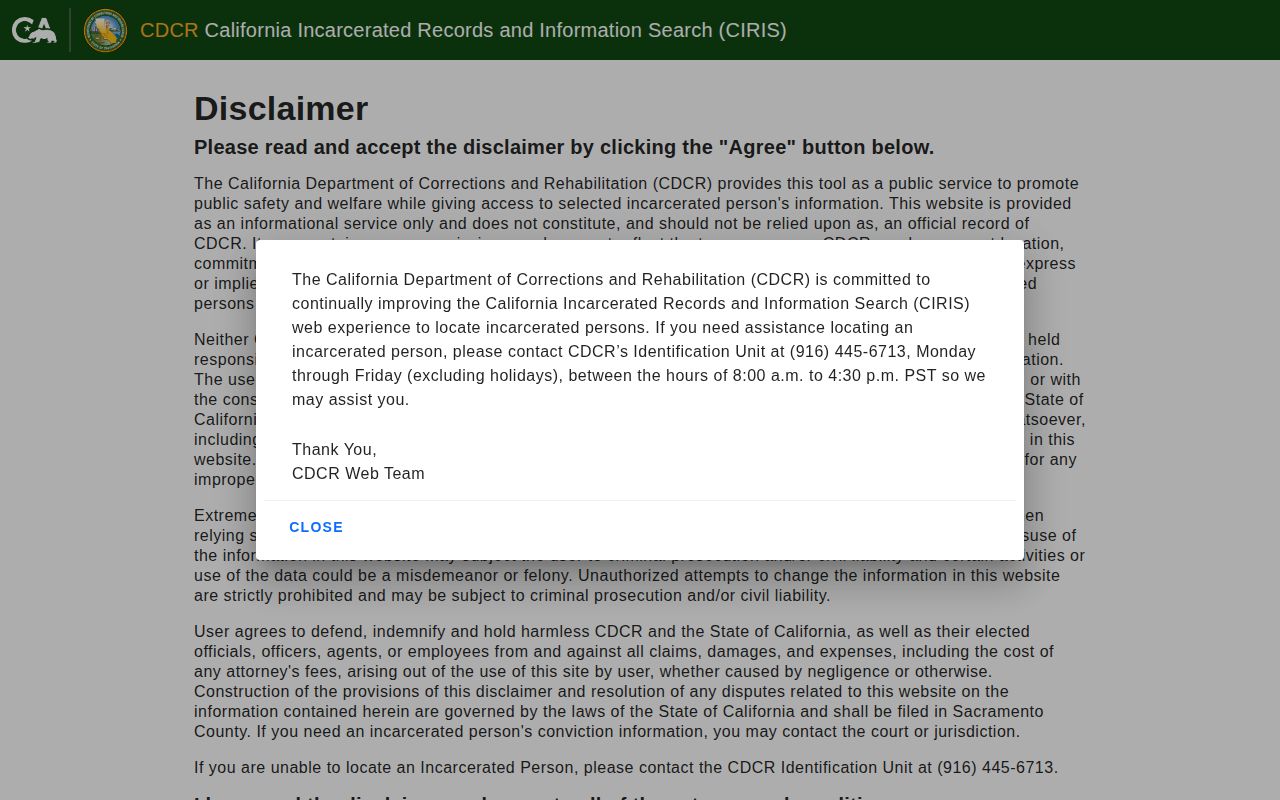
The screenshot fits PBSP release work because it shows the statewide search route, not a county jail feed. Use it to identify CDCR custody first, then verify release, parole, or discharge through the additional CDCR and court channels.
PBSP Parole and BPH
Some Pelican Bay release questions depend on the Board of Parole Hearings. BPH schedules list hearing date, time, location, and whether the hearing is in person or by video. The schedule page says schedules are updated weekly every Thursday morning. A listed hearing is not the same as a release. Outcomes can include grants, denials, continuances, postponements, rescissions, stipulations, or further review depending on the sentence and legal posture.
When a state prisoner is released to parole, the supervision record shifts to CDCR's Division of Adult Parole Operations. DAPO is separate from Del Norte County Probation. Del Norte Probation handles local county-court supervision, while DAPO supervises state parole. A PBSP parole release should be verified through CDCR/DAPO sources and any public court or BPH materials, not through the county probation office unless a separate local case exists.
- Parole
- State supervision after a prison release, handled by DAPO for CDCR cases.
- Discharge
- End of the prison sentence or supervision term when CDCR no longer supervises the person.
- Transfer
- Movement to another facility or agency, which is not the same as release to the community.
- Minute order
- A court record of what the judge ordered, often needed when a release follows resentencing or dismissal.
Pelican Bay Release Types
A PBSP release can have several meanings. The label matters because each path leaves a different public trail. Parole release points to DAPO and sometimes BPH. Determinate sentence discharge points to CDCR case records and sentence-credit calculations. Resentencing release points to court minute orders or abstracts. A transfer points to another custody system and may not be a release at all.
| PBSP event | Primary source | Confirm with |
|---|---|---|
| Current CDCR custody | CIRIS | CDCR number, location, commitment county, admission date |
| Parole consideration | BPH schedule and outcome records | CIRIS, BPH, CDCR records, DAPO |
| Release to parole | CDCR and DAPO | VINE, court records, parole contacts |
| Resentencing release | Sentencing court and CDCR case records | Abstract of judgment, minute order, release processing |
| Transfer | CDCR or receiving agency | Current location, court transport record, agency locator |
PBSP Court and VINE Records
Court records are often the source that explains why a state prisoner leaves Pelican Bay. CDCR may process an abstract of judgment, resentencing minute order, recall order, dismissal, or other court instruction. The public should not infer that a person was released merely because a hearing occurred or because a name is not found in one online search. Pair the CDCR search with the court record that changed custody or sentence status.
California VINE can add custody-change notification for participating records. It is a notification layer, not a complete state-prison release archive. If VINE shows a custody change, confirm the exact release type with CDCR, DAPO, BPH, or court records. If VINE does not find the person, use the statewide and court sources instead of assuming there was no PBSP custody.
Pelican Bay Release Types
A Pelican Bay release can mean several different things. A determinate-sentence prisoner may discharge after CDCR applies sentence credits and case-records processing. A parole-eligible prisoner may have a Board of Parole Hearings suitability process before any release occurs. A court may issue a resentencing order, recall, corrected abstract, dismissal, or other order that changes the custody term. A person may also transfer to another CDCR facility, return to court, move to county custody on a new matter, or leave CDCR custody under parole supervision.
Those release types should not be merged into one generic state-prison release. A BPH hearing date is not the same as a release date. A parole grant may still require review, victim-notification steps, detainer review, calculation, and final processing. A CIRIS location change may be a transfer rather than a discharge. A Del Norte court order can explain why CDCR changed the custody status, but CDCR remains the agency that processes the prison record and the release event.
California sentence credits add another layer. Penal Code section 2933 governs worktime credit for many determinate state-prison sentences, while section 2933.1 limits credits for qualifying violent felonies. Those rules are not applied by the county jail portal. They belong to CDCR case records and the sentencing documents, which is why a projected or expected PBSP release date should be confirmed through the state-prison record path.
PBSP release records also intersect with local Del Norte searches because families may know only that the prison is in Crescent City. The county name in the search phrase does not make the sheriff the custodian of the prison record. Start with CDCR, then use Del Norte court records only when the sentencing or resentencing case is local.
| PBSP outcome | Primary confirmation route |
|---|---|
| Parole release | CDCR records, DAPO, BPH records, VINE, and sentencing-court context. |
| Discharge after sentence | CDCR case records, CIRIS if still visible, and court sentence documents. |
| Resentencing or court-ordered release | Court minute order or abstract plus CDCR release-processing confirmation. |
| Transfer | CDCR location records, VINE if available, and receiving-agency records. |